
Table of Contents
Meta Description: A practical 2026 guide to meta description best practices — real examples, a proven framework, and mistakes even experts make. (145 chars)
URL Slug: /meta-description-best-practices-seo-2026
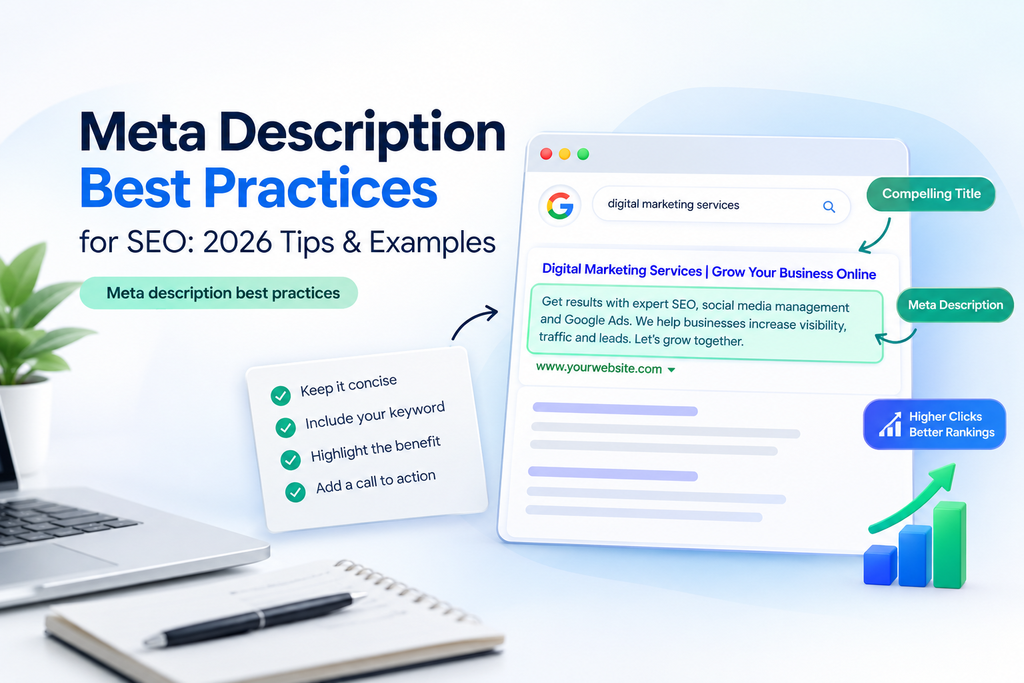
Meta Description Best Practices for SEO: Tips and Examples for 2026
There’s a version of meta description best practices advice that’s been recycled for a decade: keep it under a certain character count, include the keyword, add a call-to-action, done. It’s not wrong, exactly. It’s just incomplete.
After writing and testing meta descriptions across dozens of client sites, the pattern I keep seeing is simple — the descriptions that win aren’t the most “optimized” ones on paper. They’re the ones that sound like they were written for a person, not a crawler.
Here’s what I’ve actually learned about meta description best practices in 2026, backed by a real example and the framework I use every time. Following these meta description best practices can help you create descriptions that are clear, relevant, and more appealing to searchers.
Why a Meta Description Still Earns Its Place
Technically, a meta descriptiohttps://en.wikipedia.org/wiki/Descriptionn doesn’t move rankings. Google has confirmed this more than once. What it does is shape a decision that happens in about two seconds: does this searcher click your result, or the one next to it?
That decision matters more than people give it credit for. Two pages ranking in identical positions can pull very different amounts of traffic based purely on which one gives the searcher a reason to trust it. A weak meta description is a quiet tax on traffic you’ve already earned through ranking.
It’s Not Just Keyword Stuffing Anymore
Keyword stuffing is the mistake every beginner guide warns about, and it’s real — cramming the primary keyword in twice or three times just to “cover the bases” reads as spam the moment a human sees it.
But the mistake that persists even among experienced marketers is different: writing copy that describes the page rather than pitches the click. Compare “This page covers meta description tips” with “Here’s the exact framework I use to write meta descriptions that get clicked.” Both are accurate. Only one gives someone a reason to act.
Another important part of meta description best practices is understanding search intent. A description built for someone doing research reads completely wrong to someone ready to buy — and no amount of keyword placement fixes a mismatch in tone and offer.
Following meta description best practices means balancing relevance, clarity, intent, and persuasion rather than simply repeating keywords. When applying meta description best practices, focus on giving searchers a clear reason to click while keeping the description natural and useful.
The Framework I Use on Every Page
Nothing fancy here — just a consistent order that keeps the writing focused:
- Understand intent first. What outcome is this searcher actually after?
- Include the primary keyword early, worked in naturally.
- Lead with a benefit, not a feature.
- Add one specific, differentiating detail — a location, a number, a result.
- Close with a simple, low-friction CTA.
Skip step one and the rest of the framework doesn’t matter much — you’ll be optimizing copy for the wrong reader entirely.
From Forgettable to Effective: A Real Rewrite
A service page I worked on used to run a description close to: “We provide quality digital marketing services for businesses.” Accurate, but interchangeable with thousands of competitors’ pages.
The rewrite followed meta description best practices by naming the specific service, adding the location, and stating the actual benefit a click would deliver. Organic clicks and CTR both rose noticeably afterward — while the page’s ranking position barely moved.
That gap is the whole point: meta description best practices can help make a search snippet more relevant and compelling without changing its ranking position. In this case, applying meta description best practices helped more people choose to click at the same spot in the results.
So, How Long Should It Actually Be?
The honest answer: there’s no hard limit, just a practical range. Current display behavior puts the safe zone around 150–160 characters on desktop and roughly 120 characters on mobile before Google starts cutting the snippet short. Under the hood, this is a pixel-width limit, not a strict character count — a description full of narrow letters can run longer than one full of wide capitals and still fit.
It also helps to know Google frequently ignores the description you wrote and generates its own from the page instead, particularly when yours doesn’t closely match the query.
When applying meta description best practices, my own habit is to skip the character-counting obsession. Front-load the important message, keep the sentence tight, and write to intent rather than a target number. Good meta description best practices focus on relevance and clarity, while effective meta description best practices also ensure the core message appears early, ideally within the first 120 characters or so
| Device/Surface | Character Target | Why |
|---|---|---|
| Desktop | ~150–160 characters | Typically displays in full |
| Mobile | ~120 characters | Narrower space, cuts off sooner |
| Snippet-style results | ~45–50 words | Should read as complete sentences |
A Fast Pre-Publish Checklist
- Written around the searcher’s intent, not just the keyword
- Primary keyword appears naturally near the start
- Leads with a specific benefit, not a generic summary
- Includes one differentiating detail
- Ends with a simple, clear CTA
- Core message sits within roughly the first 120 characters
- No repeated or forced keyword use
- Sounds natural when read aloud
Mistakes That Quietly Kill Click-Through Rate
Keyword stuffing. Repetition doesn’t help CTR — it just signals low effort.
Vague, generic phrasing. “Learn more about [topic]” repeats the title without adding value.
Writing to the keyword, not the searcher. Matching the term isn’t enough if the offer or tone misses the intent.
Optimizing for a precise character count over clarity. A clean 140-character line beats a padded 160-character one nearly every time.
Copy-pasting descriptions across pages. Invites keyword cannibalization and confuses both users and search engines about which page answers what.
Frequently Asked Questions
Does a meta description directly affect rankings?
No — Google has confirmed it isn’t a ranking factor. It does influence click-through rate, which affects overall page performance.
What if I leave it blank?
Google auto-generates a snippet from your content, often pulled from mid-paragraph with none of the persuasive framing a written description provides.
Should the exact keyword appear every time?
Once, naturally, early in the sentence is enough. Repeating it doesn’t help and often hurts readability.
Final Takeaways
A meta description isn’t a box to check for SEO compliance — it’s a short, honest pitch for why your result deserves the click. Start with intent, lead with a real benefit, and keep the message tight enough to survive truncation wherever it’s displayed. Do that consistently, and the click-through gains follow on their own.
Looking for the best digital marketing strategist in Malappuram? Srijinkk helps businesses improve their online presence through SEO, social media management, and Google Ads with practical strategies focused on visibility, growth, and reaching the right audience.