
Table of Contents
A few months ago, a potential customer typed a simple question into ChatGPT: they needed a local SEO and digital marketing agency to improve their business’s online visibility. ChatGPT recommended one specific agency by name. That person clicked through, filled out the enquiry form, and eventually signed on as a paying client.
That’s what AI search visibility to local leads actually looks like in practice — not a theory, but a real enquiry landing in someone’s inbox because an AI tool decided their business was worth recommending.
If you run a local business and you’re wondering whether AI search visibility to local leads can genuinely turn into local leads, the answer is yes. But it doesn’t happen by accident, and it doesn’t happen overnight. Here’s exactly how AI search visibility to local leads works, based on what actually moved the needle for one agency’s own client./
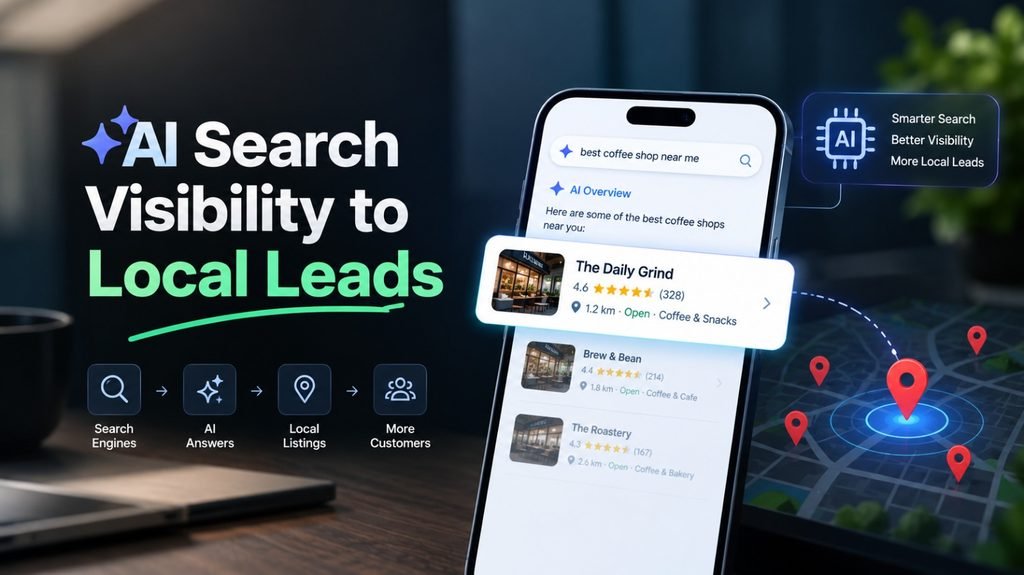
Why best AI Search Visibility to Local Leads Now Matters for Local Businesses
Search behavior has shifted. People aren’t just typing “SEO agency near me” into Google and scrolling through ten blue links anymore — they’re asking ChatGPT, Gemini, or Perplexity to just tell them who to hire.
A 2026 BrightLocal survey found that 45% of consumers had used AI tools like ChatGPT, Gemini, and Perplexity to find local businesses in the past year, up from just 6% the year before. That’s a massive, fast shift in how people discover local services — and most businesses haven’t adjusted for it yet.
This creates a real opportunity for AI search visibility to local leads. If AI search engines can clearly understand who you are, what you offer, and where you operate, you have a genuine shot at being the name they recommend — and turning AI search visibility to local leads into real enquiries.
For local businesses, AI search visibility to local leads is becoming an important part of adapting to changing search behavior and making your business easier for AI-powered search tools to discover and recommend.
A Real Example: How One AI Recommendation Became a Paying Client
Here’s what actually happened. A local digital marketing business offering SEO and online marketing services appeared in a ChatGPT recommendation when someone searched for a local SEO/digital marketing agency to improve their online visibility.
The customer clicked through to the website, submitted an enquiry, and later became a paying client — all because ChatGPT decided this business was a credible answer to that person’s question. This is a clear example of how AI search visibility to local leads can connect AI recommendations with real customer enquiries.
That single moment is proof of something bigger: AI search visibility to local leads isn’t just influencing brand awareness. It can directly feed the sales funnel, from the first search to a website visit, enquiry, and signed client.
For local businesses, AI search visibility to local leads means creating a strong online presence that AI systems can understand, trust, and potentially recommend when customers are looking for relevant services.
The best Step-by-Step Framework for Turning AI Visibility Into Leads
After seeing that first AI-driven lead come through, the natural next question was: how do you make that happen consistently, not just by luck? Here’s the process, in order:
- Get your business information accurate everywhere. Business name, address, phone number, services, and location details need to match exactly across your website, Google Business Profile, and other listings.
- Do local keyword research. Identify the specific terms people use when searching for your service in your area.
- Optimize your website. Make sure your service pages clearly state what you offer and where you operate — don’t make AI tools guess.
- Optimize Google Business Profile. Keep it complete, accurate, and active.
- Strengthen reviews. AI tools lean heavily on reviews to decide who to recommend.
- Add FAQs and location-specific content. This gives AI systems clear, quotable answers to match against real search queries.
- Monitor and adjust. Track visibility, referrals, and leads, then keep updating content based on what customers are actually searching for.
Of all these steps, location-focused keywords made the single biggest difference. Clearly connecting the business to relevant local searches is what helped AI systems match it to the right queries in the first place.
What to Expect Timeline-Wise
Set realistic expectations here: after making these changes, it typically took 4 to 8 weeks to start noticing increased AI search visibility and enquiries. This isn’t an overnight switch — it’s a build.
The Biggest Mistake That Kills AI Search Visibility
The most common mistake local businesses make is having inconsistent business information across their website, Google Business Profile, and other online listings.
For AI search visibility to local leads, consistent business information is essential. If your address is formatted one way on your website and another way on a directory, or your phone number doesn’t match across platforms, AI search engines may struggle to confidently verify who you are — and an unclear answer may be less likely to appear in recommendations.
Maintaining accurate and consistent information is an important part of improving AI search visibility to local leads and making your business easier for AI systems to understand and recommend. This consistency can ultimately support AI search visibility to local leads by strengthening the clarity of your online business information.
Fix this first, before anything else: lock down your business name, address, phone number, services, and location details so they’re identical everywhere.
How to Track Whether a Lead Actually Came From AI Search
This is where a lot of businesses get stuck — AI referral traffic doesn’t always show up clean and labeled in your analytics. Here’s what actually works:
| Method | What It Tells You |
| GA4 | Referral source data, including some AI platform referrals |
| Google Search Console | Whether your pages are being indexed and matched to relevant queries |
| UTM tracking | Precise source tracking if you can get AI tools to include tagged links |
| Lead forms | Source-of-discovery fields you control directly |
| Asking new leads directly | The most reliable confirmation — simply ask how they found you |
Combining analytics tools with a simple question on your enquiry form — “How did you hear about us?” — gives you the clearest picture. Several new leads have directly confirmed they found the business through ChatGPT, which is often the only definitive way to know for sure.
Frequently Asked Questions
Does AI search visibility actually generate real leads, or just brand awareness?
It can generate real leads. In the example above, an AI recommendation led directly to a form submission and a paying client — not just a visit.
How long does it take to see results from optimizing for AI search?
Typically 4 to 8 weeks after making consistent changes to business information, listings, and content, though this can vary based on competition and how established the business already is online.
What’s the single most important factor for AI search visibility?
Consistent, accurate business information (name, address, phone number, services, location) across every platform, paired with clear local keyword targeting.
Can I track exactly which leads come from AI search tools like ChatGPT?
Not perfectly — AI referral tracking is still limited. A combination of GA4, Search Console, UTM tracking, and directly asking new leads how they found you gives the most reliable picture.
Looking for the best digital marketing strategist in Malappuram? Srijinkk provides strategic digital marketing solutions focused on SEO, social media management, and Google Ads to help businesses improve online visibility, reach the right audience, and grow their digital presence.
Pingback: Elementor #364 - Srijin k k